
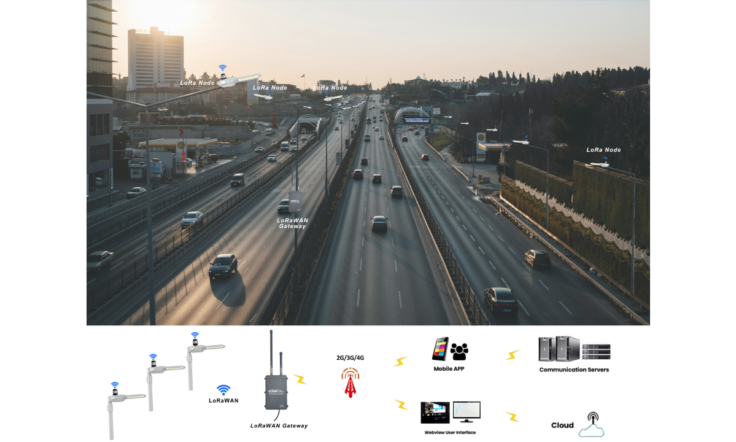
With the concept of smart cities, smart transformations are also demanded in street and road lighting in cities. Under the Paris Agreement, countries have commitments to responsible consumption, sustainable smart cities, and climate action. A control system serving these actions will contribute to achieving multiple goals. Therefore, IoT-based lighting control systems have become a popular and in-demand system worldwide.
The wireless infrastructures that will serve all Smart Cities use technologies such as Bluetooth, Zigbee, GSM, or LoRaWAN. The Zigbee solution is not preferred due to its high cost per luminaire, the Bluetooth communication method cannot serve the entire city and is generally preferred indoors, and GSM-based systems incur monthly subscription costs per luminaire for service providers.
LoRa wireless technology, named after the initials of Long Range, which provides long-distance communication in urban lighting, has become popular worldwide. Our system is equipped with LoRaWAN wireless technology.
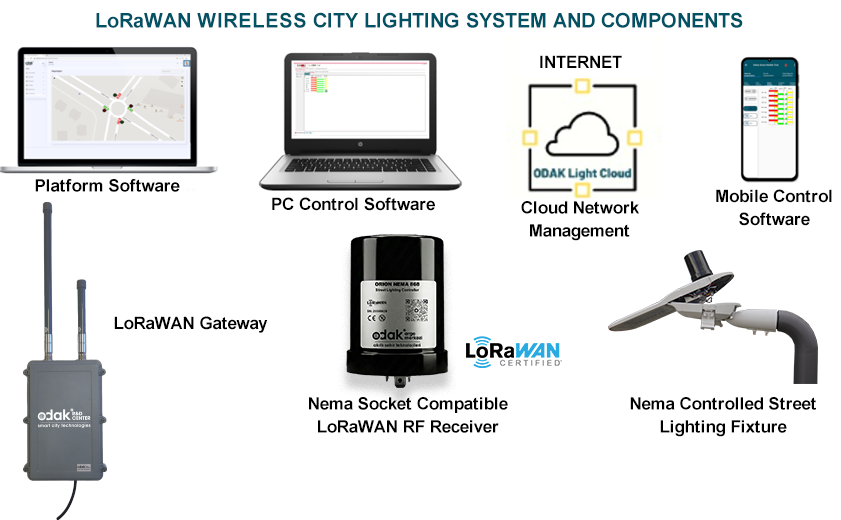
In street lighting fixture control, the American-made NEMA and the relatively newer Zhaga Socket have entered our lives. Our system uses RF receivers compatible with the more widely preferred NEMA Socket. This allows you to use all ANSI C136.41-compliant NEMA socket fixtures without any issues.
Advantages Provided by the System
- SDG 11,12,13 (Responsible consumption, sustainable smart cities, climate action)
- Contributing to energy savings and reducing carbon emissions
- IEC Adaptive Adjustment – Dynamic Lighting
- Long-range communication capability (LoRa)
- Remote fault detection, saving on maintenance and labor costs
- Interoperable with LoRaWAN
- Lighting Fixture Control and Asset Management,
LoRaWAN Gateway
General Information
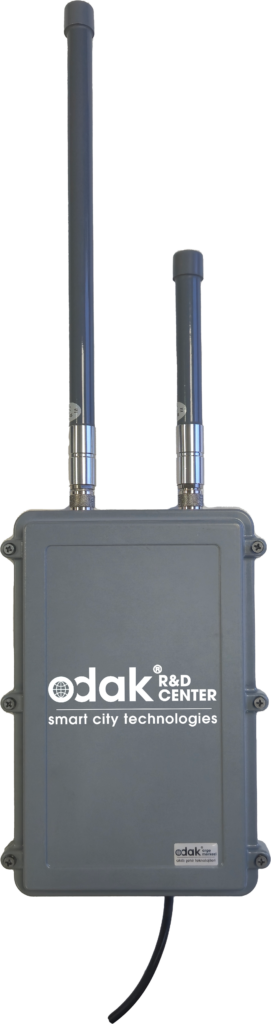
LoRa Data Collector that enables individual communication with nodes using a 470/868/915 MHz wireless interface.
In addition to its primary functions, the LoRa data collector controls all electrical equipment in the cabinet, collects data from the electricity meter and other connected devices, and sends the live status of the entire LoRa system to the server via the GSM/GPRS/3G mobile network. LoRa data collector programming and light level programming are performed remotely via software.
- Input Voltage: 100 – 277 VAC 50/60 Hz
- Power: 2W
- Power Factor: >0.9
- Protocol: LoRaWAN
- RF Frequency: 470/868/915 MHz
- RF Tx Power: 17 dBm
- Control Capacity: 200 Fixtures (Maximum)
- Protection Class: IP66
- Operating Temperature: -40°C / +70°C
- Body: Aluminum
- Voltage Protection: 10 kV
- Weight: 4kg
- Dimensions: 230×200.5×85
ORION Nema Socket Compatible LoRaWAN RF Smart Lighting Controller
General Information
ORION-NEMA-868 is a smart luminaire controller developed for NEMA standard socketed lighting fixtures, offering remote monitoring and control capabilities. This device uses LoRaWAN communication technology to reliably transmit luminaire data to a remote server via a gateway.
The controller is compatible with 1–10 V supported drivers and is designed for use in various street lighting applications such as residential, urban, and road lighting. The system allows remote control of luminaire switching and dimming, while measurement parameters such as current, voltage, power, energy, temperature, humidity, and dimming level can be periodically monitored and reported.
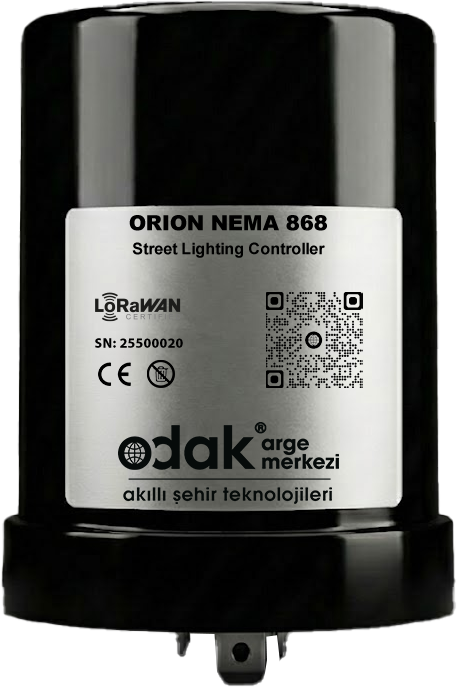
Communication
- Frequency Band: 868 MHz
- Transmission Power: +16 dBm
- Receiver Sensitivity: -138 dBm
- Compatibility: LoRaWAN 1.0.2
- Antenna Connection: Internal (PCB)
Dimming Interface
- 0-10V/PWM: Current
- DALI-2: Not available
Electrical Properties
- Operating Voltage Range: 100-277 /185-277VAC
- Maximum Voltage: 265V AC or 305V DC
- Maximum load current:4.8 A
- Power Consumption: < 2 W
- Overvoltage protection: 6 kV
- Maximum load power: 1 kW
Mechanical Properties
- Socket connection: NEMA7-ANSI C136.41
- Dimensions: 98 mm height and 84 mm diameter
- Weight: < 200gr
- Material: Polycarbonate housing
Functional Features
- Measurements: Voltage, current, temperature, humidity, light intensity
- Calculations: RMS voltage, RMS current, frequency, active power, reactive power, apparent power, power factor, active energy
- Accuracy: < 1%
Environmental Working Conditions
- Operating Temperature Range: Between -25 °C and +55 °C
- Protection Class: IP68, IK08
- Service Life: 5 years
Power supply and control signals are transmitted to the luminaire driver via a NEMA socket compliant with the ANSI C136.41 standard. In addition to the phase (L) and neutral (N) lines, a 1-10 V dimming line (DIM+/DIM-) is supported.
This structure enables the standard and direct integration of NEMA-compliant smart lighting control devices into the fixture.
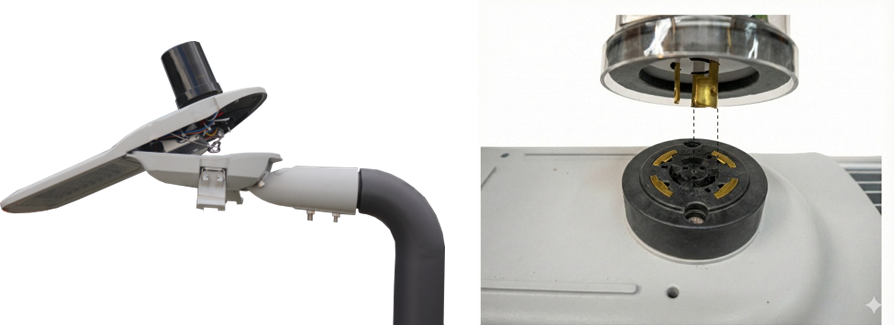
ORION Zhaga 868
General Information
ORION Zhaga 868 is a plug-and-play smart lighting control unit developed for Zhaga Book 18 compliant LED luminaires. Thanks to its socket-type mounting structure, it integrates quickly and securely onto the luminaire.
The device controls the luminaire driver via the DALI communication interface and provides remote management capabilities depending on the selected communication infrastructure..
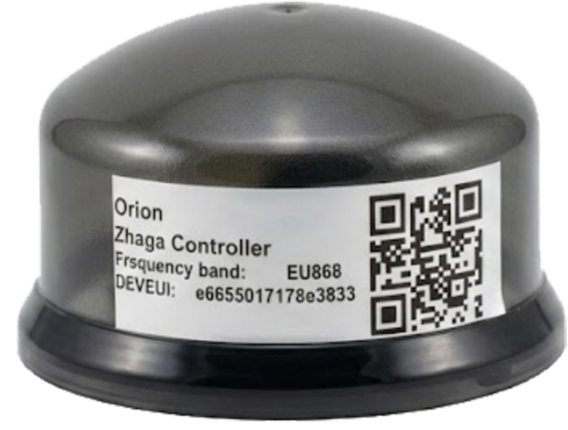
Key Features
- Zhaga Book 18 compliant mechanical and electrical interface
- DALI and 0-10V dimming interface
- LoRaWAN communication
- Photosensor and GPS support
- OTA (Over-The-Air) firmware update support
- Internal high-precision RTC (with backup battery)
- Time-based automatic dimming scenarios
- Manual / Sensor / Timer modes
- Support for customizable dimming profiles
- OpenAPI integration support
LoRaWAN Network Parameters
- Class: C
- Activation: OTAA
- Link Budget : 187 dBm
- Supported Regions: EU868
Cellular Network Parameters
- GSM: 850/900/1800/1900 Mhz
Mechanical Properties
- Power Supply: 12 Vdc – 24 Vdc
- Power Consumption: < 0.5W @ 24 Vdc input
- Socket interface: Zhaga book 18 compliant
- Dimming Interface: DALI/0-10V
- Network communication: LoRaWAN
- Dimming mode: Manual mode, sensor mode, scheduling mode
- Dimensions: 80.15mm*80.15mm*55.56mm
- Weight: 85g ± 5g
- Operating temperature: -30°C to 60°C
- Storage temperature: -40°C to +70°C
- Protection class: IP66
- Body material: PC (Polycarbonate)
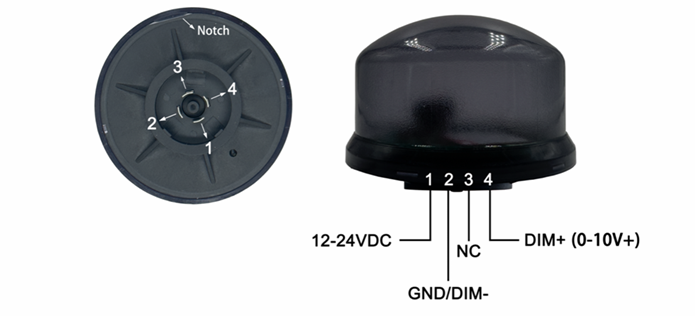
| Number of Pins | 0-10V/PWM Type | DALI Type |
|---|---|---|
| 1 | Power input (12Vdc – 24Vdc) | Power input (12Vdc – 24Vdc) |
| 2 | DIM- (GND) | DALI- (GND) |
| 3 | RFU | DALI+ |
| 4 | DIM+ (0-10V/PWM) | RFU |
- Pin 1: 24V auxiliary power input (24V POWER – AUX). Used to supply power to external devices.
- Pin 2: DALI negative line (DALI – / SR–).
- Pin 3: DALI positive line (DALI + / SR+).
- Pin 4: Together with pins 1, 2, and 3, it forms the sensor input section and is used to receive sensor signals.
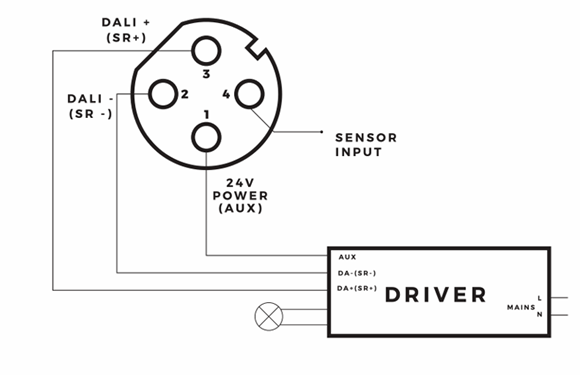
- During wiring, it is mandatory that the conductors belonging to external devices are connected correctly and completely to the relevant pins.
- The auxiliary power supply (AUX), DALI negative (DA– / SR–), and DALI positive (DA+ / SR+) terminals on the control device must be correctly connected to the corresponding inputs on the driver (DRIVER).
- The LED driver also has L (Line/Phase) and N (Neutral) terminals for mains connection, and these terminals must be connected directly to the mains supply.
- During the connection process, attention should be paid to correct polarity and pin matching.